Now Reading: The Aaron Boone Yankees Playoff Script Never Changes
-
01
The Aaron Boone Yankees Playoff Script Never Changes


The New York Yankees’ season was always going to end this way. That’s because every New York Yankees season of this era ends this way, spiritually speaking. From the moment Aaron Boone succeeded Joe Girardi as Yankees manager in December 2017, he’s done two things: win consistently during the regular season and lose consistently during the playoffs. Why would 2025 be any different?
The latest playoff letdown came in the ALDS against the Toronto Blue Jays. The Yankees lost Wednesday’s Game 4, 5-2, sending them home for the offseason as Toronto advances to the ALCS. The pivotal moment came in the seventh inning with the Jays leading 2-1. With a man on first and one out, Toronto shortstop Andrés Giménez hit a ground ball to Jazz Chisholm Jr. that should have resulted in a double play. Instead, it bounced off Chisholm’s glove and careened into center field, allowing Giménez to reach safely. Two batters later, Toronto outfielder Nathan Lukes laced a two-run single that cracked the game open.
The error was far from the Yankees’ only shortcoming in this series. They were outscored 34 to 19, and outhit 50 to 34. Their starting pitchers in the first three games (Luis Gil, Max Fried, and Carlos Rodón) posted a combined ERA above 16; meanwhile, Jays rookie pitcher Trey Yesavage—who had made only seven career MLB starts before the playoffs—no-hit them through 5 1/3 innings in Game 2, striking out 11. The Yankees trailed 11-0 through four innings in that game, at which point they had fewer balls put in play (two) than the Blue Jays had home runs (three).
The Yankees staved off a sweep thanks to the Game 3 heroics of Aaron Judge, who put the narratives about his postseason failures to bed by going 9-for-15 with an astonishing home ru and six RBIs. But New York’s other top bats were mostly silent. Giancarlo Stanton was 4-for-15. Cody Bellinger was 3-for-16. Ben Rice was 2-for-11, Chisholm was 2-for-14, and Trent Grisham was 2-for-17.
“It’s hard to win the World Series,” Boone said after the Yankees were eliminated. “I’ve been chasing it my whole life.”
There’s plenty of blame to go around. What’s new with this loss, though, is less important than what’s familiar. Eight seasons in, this is the defining experience of Boone’s tenure. His lineups go cold in October. His defense is burned by simple mistakes. And his decision-making falters in the biggest moments.
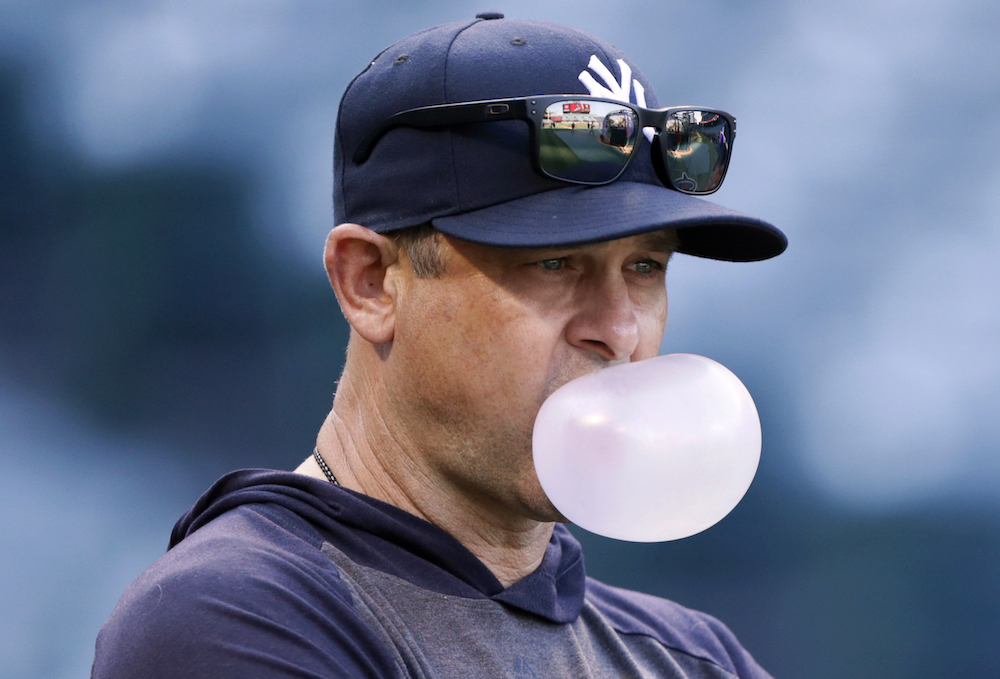
Boone came to the postseason to chew bubblegum and face-plant. And he’s all out of bubblegum.
To understand why this Yankees playoff exit feels so damning, it’s important to have the proper context. Sure, Boone has a .584 career regular-season winning percentage, a mark that ranks 15th in MLB history, behind John McGraw and ahead of Earl Weaver. Sure, from 2018 until now, the Yankees have won more regular-season games (697) than any teams not named the Dodgers (749) and Astros (705). But the Yankees are also 25-27 in the postseason under Boone, and 10-23 against opponents who aren’t from the AL Central More than that, his résumé includes some unforgettable managerial blunders:
- In Game 3 of the 2018 ALDS, Boone let starter Luis Severino begin the fourth inning against the Red Sox after he’d given up three runs and six baserunners in the first three frames. Severino allowed Boston to load the bases, setting the stage for a seven-run inning and an eventual 16-1 loss. This, after Severino reportedly showed up late to Yankee Stadium because he forgot what time the game started.
- In Game 2 of the 2019 ALCS, Boone replaced reliever Chad Green with Adam Ottavino in the fifth inning against the Astros. Green had looked unhittable to that point: He’d retired all six batters he faced, throwing 21 of 26 pitches for strikes. Ottavino gave up a home run to George Springer on the very first pitch he threw. After the game, Ottavino told reporters that the decision had been made for him to face Springer regardless of how effective Green was. This came a day after Ottavino also faced Springer in Game 1. “Obviously,” Ottavino said, “the more exposure a hitter gets against a pitcher in a series the more it helps the hitter.”
- In Game 2 of the 2020 ALDS, Boone deployed rookie Deivi Garcia as an opener against the Rays before calling for veteran J.A. Happ in the second inning. This tack—which came as a surprise not only to the Rays, but also to the Yankees—failed spectacularly. Garcia gave up a home run in the bottom of first before Happ allowed four earned runs over 2 2/3 innings. When asked about the strategy after the game, Happ referred reporters to Boone. “I’ll let Aaron talk about that,” he said.
- In Game 3 of the 2022 ALDS, Boone turned to Clarke Schmidt instead of closer Clay Holmes to protect a 5-3 lead against Cleveland in the ninth inning. Schmidt allowed three of the four hitters he faced to reach base; the Guardians won 6-5. Afterward, Boone told reporters that Holmes hadn’t been available to pitch in the game. Holmes told reporters the opposite. “The decision wasn’t mine,” Holmes said.
- In Game 1 of the 2024 World Series, Boone called on Nestor Cortes Jr.—a starter who had not pitched in an MLB game in five weeks while recovering from an elbow injury—to face the heart of the Dodgers lineup in extra innings with the Yankees clinging to a 3-2 lead. Cortes allowed a walkoff grand slam to Freddie Freeman. Cortes was tapped over Tim Hill, a lefty reliever who had allowed just one earned run over 5 2/3 innings through the first two rounds of the playoffs, and who’d posted a 1.33 ERA across 27 innings in the final two months of the regular season. When asked why he went with the pitcher who hadn’t faced MLB hitters in more than a month instead of the pitcher who had been lights-out for three months, Boone told reporters, “I liked the matchup.”
- In Game 1 of the 2025 wild-card round, Boone removed Fried in the seventh inning against the Red Sox because his pitch count was too high. This, even though Fried had dominated over 6 1/3 shutout innings, and said after the game that he was “gonna stay in until I get the ball taken from me.” Boone turned to reliever Luke Weaver, who had posted a 9.64 ERA over his last 10 innings since the start of September. Weaver allowed a walk, a double, and a single before getting pulled. The Yankees lost, 3-1.
The common thread here is not just that Boone makes playoff mistakes. It’s that many of his mistakes are glaringly obvious the exact moment he makes them. There’s a line of competitive thought that the best strategy is to do what your opponent wants you to do least. Boone has never heard of this, or at the least doesn’t subscribe to it.
This dovetails with one of the loudest and most persistent criticisms of the Boone era: that he is simply adhering to a script. That he is handed an analytical roadmap by general manager Brian Cashman and the front office, and that he follows it, unwaveringly, regardless of the circumstances. YES play-by-play man Michael Kay ripped the team for this after Boone turned to struggling reliever Devin Williams in the eighth inning of a scoreless game against the Rangers in August. (The Yankees lost 2-0.) “I think that Aaron Boone is managing the way the organization wants him to manage,” Kay said on his radio show. “Those are the rules of engagement.” Kay reiterated this sentiment after a 4-1 loss to the Twins a few weeks later, when Boone inserted low-leverage option Yerry De los Santos into a game that was tied in the sixth inning despite having a fully rested bullpen. “This is all prepackaged, preplanned,” Kay said.
Former players have weighed in, too. “I remember being told by a specific person in the analytics department that they didn’t believe in, like, players getting hot,” Clint Frazier, who played outfield for the Yankees from 2017 to 2021, said on Foul Territory in June. “I could be 55-for-55 and they would be like, ‘He’s not hot. He’s gonna cool down.’ They believed you were what you were. And in my mind, I was like, but that’s not using your eyes.”
Cashman, to be clear, has also taken plenty of heat along these lines. “When Cashman comes out and gives support to Boone, lowkey, I kind of feel like that’s self-preservation,” Frazier said in August. “Boone is Cashman’s shadow a little bit.” In 2023, fans chanted “Fire Cashman” at Yankee Stadium, and some hung a banner with that messaging this July. But Boone is the one in the dugout. The choices about which buttons to push in the biggest moments are his and his alone.
The Toronto series featured only one obvious tactical misstep: In Game 1, with the Yankees trailing 2-1 in the seventh, he again turned to Weaver, who allowed all three batters he faced to reach bas in what would become a five-run frame. But Boone didn’t blow it more than that because the Yankees didn’t give him a chance to blow it more than that. To blow it, you typically have to have a lead. The Yankees led for only six of the 36 innings in this series.
There’s a well-known scene from The Office in which Michael Scott drives his car into a lake. His GPS keeps telling him to make a right turn, and, in his interpretation, this is what the GPS means.
This is how the Yankees have operated for Boone’s entire tenure. The front office has given the directions. Boone has unquestioningly followed them. And once again, the team is sunk.
Part of the irony here is that Boone was hired for his ability to mesh with the clubhouse. When the Yankees let Girardi walk after the 2017 season, the organization’s main talking point was that the manager no longer was connecting with players, and with the team’s young core in particular.
“As we try to continue to be an evolving, progressive franchise was it time for a new voice and a fresh voice?’’ Cashman said in explaining his decision to move the franchise in a different direction. “I made that recommendation based on a number of few years now from experiences that I was able to validate whether it was directly or indirectly about the connectivity and communication level with the players in that clubhouse.’’
At various points throughout his tenure, Girardi made headlines for his less-than-stellar relationships with Yankees stars: Jorge Posada, Aroldis Chapman, Gary Sánchez, and more. In 2014, it was even reported that the manager preempted Derek Jeter’s final home game at Yankee Stadium by launching into a tirade over the team’s middling performance that season; according to an article from Wallace Matthews and Andrew Marchand “Girardi chided some players for being overweight and others for not being ‘hungry’ enough.” Boone, who lacked prior managerial experience but seemed universally well-liked throughout the sport, was supposed to be the antidote. He would be the type of manager who has his players’ backs.
And in a sense, he has. He never airs them out publicly for their mistakes, to the extent that much of the fan base believes he’s overly protective and has created a culture that lacks accountability. But in another sense, he hasn’t. Time and again, Boone has elected to follow the front office’s mandates over his players’ own preferences. Time and again, that approach has failed. And time and again, Boone’s message has been unable to get through to the Yankees’ roster when it’s been most in need of a spark.
Boone inherited a young clubhouse on the precipice of greatness. He now has an old clubhouse desperate to win a World Series before the best players age out of their respective primes. By the start of next season, Fried will be 32. Judge and Rodón will be 33. Gerrit Cole, who is rehabbing from Tommy John surgery, will be 35. Stanton will be 36.
What will the Yankees do next? Will they choose to keep Boone around for a ninth season knowing he’ll likely lead the club to 90-plus wins and a playoff berth before his inevitable collapse? Will they fire him in an attempt to reverse course before Judge joins Barry Bonds and Mike Trout on a different sort of historical list? Will Cashman’s future with the club come into question? And if not, is he willing to work with a manager who’s more apt to provide pushback on his game-planning directives?
Not so long ago, it was all right in front of Boone with the Yankees. Now … well, it’s not what you want.
Related Posts

Stay Informed With the Latest & Most Important News









Advertisement