Now Reading: First phase of Gaza ceasefire plan nearly complete, says Netanyahu | Israel
-
01
First phase of Gaza ceasefire plan nearly complete, says Netanyahu | Israel
First phase of Gaza ceasefire plan nearly complete, says Netanyahu | Israel

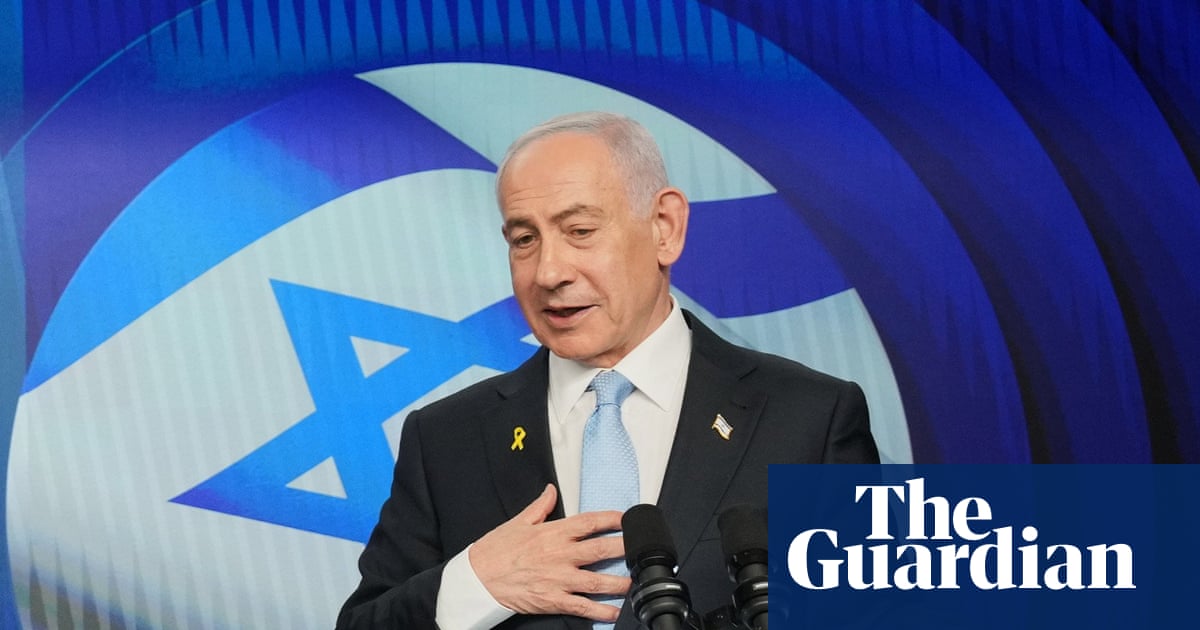
Benjamin Netanyahu has said that the first phase of the UN-endorsed Gaza ceasefire plan is close to completion, and that the second phase must involve the disarmament of Hamas.
The Israeli prime minister said he would discuss the next steps later this month in Washington with Donald Trump, whose Gaza proposals were codified in a UN security council resolution on 17 November.
“We’re about to finish the first stage,” Netanyahu said. “But we have to make sure that we achieve the same results in the second stage, and that’s something I look forward to discussing with President Trump.”
The prime minister was speaking at a joint press conference with the German chancellor, Friedrich Merz, who said: “Phase two must come now and then phase three must also be considered.”
Merz is the first leader of a major European state to meet Netanyahu in Israel since the international criminal court issued arrest warrants for the Israeli prime minister and his former defence minister, Yoav Gallant, in November last year for war crimes and crimes against humanity in Gaza.
After winning federal elections in February, Merz had said he would invite Netanyahu to Germany despite the ICC warrants, but said on Sunday a visit was not currently under consideration. Netanyahu dismisses the warrants as “trumped-up charges” from a “corrupt prosecutor”.
During the first phase of the current ceasefire agreement, Hamas released the last 20 living Israeli hostages in exchange for about 2,000 Palestinian detainees held by Israel, and it has handed over all but one of 28 bodies of hostages killed during the war. Meanwhile, Israeli forces have withdrawn to a ceasefire line, leaving them in control of 58% of the Gaza Strip.
Since the ceasefire was declared on 10 October, Israeli forces have killed more than 360 Palestinians, including an estimated 70 children. Three Israeli soldiers have been killed in Hamas attacks over the same period.
Neither Trump’s proposals, nor UN security council resolution 2803 which largely endorsed them, set out a timetable extending the ceasefire into a lasting peace. Hamas is supposed to disarm, Israeli troops are meant to withdraw farther, and an international stabilisation force (ISF) is to be set up under the control of a “board of peace” of world leaders chaired by Trump, overseeing a technocratic Palestinian committee to run the day-to-day governance of Gaza.
The sequencing of these steps is not clear in Trump’s proposals or in resolution 2803. In his remarks on Sunday, Netanyahu put his emphasis on Hamas disarmament.
“I think it’s important to make sure that Hamas complies not only with the ceasefire, but also with their commitment which they undertook to disarm and have Gaza demilitarise,” he said.
Netanyahu raised the prospects of “alternatives” to the ISF, without explaining what those might be. He would not rule out Israeli annexation of the West Bank, describing it as a subject of “discussion”, and stressed that Israel was adamantly opposed to the creation of a Palestinian state, the aim of the peace process desired by most European and Arab capitals as well as the overwhelming majority of UN member states.
Netanyahu said the reason he would not be able make a return visit to Germany was the ICC arrest warrants, which he described as fabricated by the court’s chief prosecutor, Karim Khan, as a means of diverting attention from allegations of sexual harassment against him. Khan has denied any wrongdoing, but stepped aside from his role in May pending the conclusion of an investigation.
Netanyahu said Khan was “destroying the reputation of the ICC” with “trumped-up charges of starvation and genocide” from a “corrupt prosecutor”.
Another tribunal, the international court of justice, is weighing up charges that Israeli has committed genocide in Gaza. In September, a UN independent commission of inquiry concluded that Israel had committed genocide.
Asked about the possibility of Netanyahu visiting Germany, Merz told reporters on Sunday: “There is no reason to discuss this at the moment.”
Related Posts

Stay Informed With the Latest & Most Important News
Previous Post
Next Post










Advertisement