CNN
—
A marathon voting session on President Donald Trump’s sweeping domestic policy bill is underway in the Senate and has stretched overnight into the early hours of Tuesday morning after a weekend of negotiations and delays.
The vote-a-rama – an open-ended, hourslong series of votes on amendments, some political, some substantive – started around 9:35 a.m. on Monday and is still going with no end in sight. The extended voting session provides an opportunity for Republicans to make any eleventh-hour adjustments to the package and Democrats to push on GOP weak points in the bill and put their colleagues on the spot. Those politically tough votes are likely to provide fodder for campaign ads down the line.
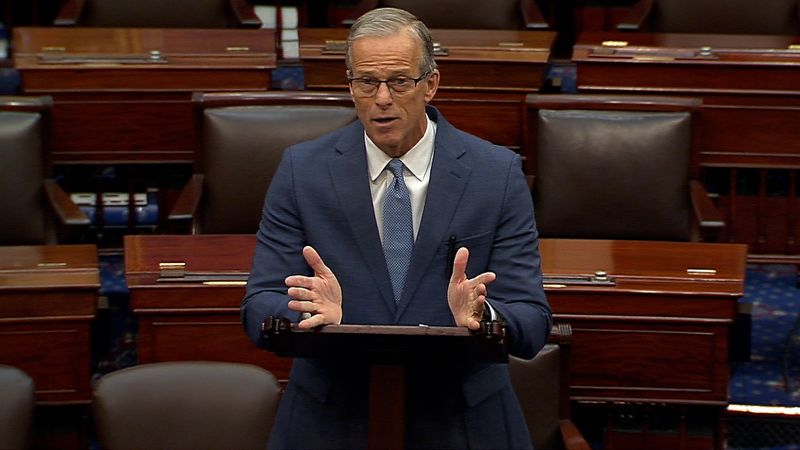
Senate Majority Leader John Thune told reporters around 1 a.m. on Tuesday that “progress is a very elusive term” when asked if lawmakers are making progress toward a final vote.
Trump’s multitrillion-dollar bill would lower federal taxes and infuse more money into the Pentagon and border security agencies, while downsizing government safety-net programs including Medicaid.
Democrats have zeroed in on Medicaid and other safety-net programs, such as food stamps, as they message against the president’s agenda. The vote-a-rama comes after Senate Democrats employed a major delay tactic over the weekend that forced clerks to spend more than a dozen hours reading aloud the entire bill.
Lawmakers are up against an extremely tight timeline to pass the legislation. The president has demanded Congress deliver the bill to his desk by the Fourth of July, but the measure must still go back to the House if it passes the Senate.
In the House, Speaker Mike Johnson is confronting growing levels of consternation in his ranks about the final product, raising questions about that measure’s fate in his chamber.
A number of Republicans in each chamber are closely watching any changes made to Medicaid provisions in the bill.
In the Senate, Alaska Republican Sen. Lisa Murkowski – who GOP leadership had to convince to advance the legislation over the weekend – crossed the aisle to vote with Democrats on several amendments affecting the bill’s SNAP and Medicaid provisions, as well as to shore up support for rural hospitals. The proposed changes were ultimately unsuccessful, but underscore the flashpoints within the Republican Party.
GOP Sen. Susan Collins of Maine offered an amendment during the vote-a-rama aimed at raising more money for rural health care providers, a move that comes as changes to Medicaid’s provider taxes in the bill have been contentious for the GOP.
The funds for this would come from increasing taxes on those who make more than $25 million annually, or couples who make more than $50 million. The Senate ultimately took a procedural vote on the amendment, rather than voting on the amendment itself, and it failed to advance.
Asked if she was disappointed by the outcome of the vote, Collins said “I was surprised at the hypocrisy of the Democrats on it. Had they voted for it, it would have passed easily. So that was a surprise.”
However, Collins maintained that her amendment’s failure to advance “has absolutely no impact on my vote on final passage.”
“We’ll see what the final bill looks like,” she added. “I’m not going to announce that prematurely.”
The Senate version of the megabill would leave 11.8 million more people without health insurance in 2034, according to a Congressional Budget Office analysis released over the weekend. That’s more than the 10.9 million more people projected to be left uninsured by the House-passed version of the bill.
Both chambers are calling for historic spending cuts to Medicaid, which provides coverage to more than 71 million low-income Americans, including children, senior citizens, people with disabilities and other adults. The package would also enact changes to the Affordable Care Act that are projected to reduce enrollment in the landmark health reform law that Trump and Republicans have long sought to dismantle.
But the Senate version calls for even deeper cuts to the Medicaid, leading to the larger estimate.
It would slash federal support for Medicaid by $930 billion over a decade, Sen. Ron Wyden, the top Democrat on the Senate Finance Committee, said over the weekend, citing a CBO estimate. The House version is projected to reduce federal spending on the program by about $800 billion, according to the CBO.
Both chambers would require certain able-bodied adults ages 19-64 to work to maintain their Medicaid benefits for the first time in the program’s 60-year history. But the Senate version would impose the work requirement on parents of children ages 14 and older, while the House version would exempt parents of dependent children.
The Senate version would also lower the cap on the taxes that states levy on health care providers to help fund the program and increase reimbursement rates for providers. However, that provision would apply only to the 40 states and the District of Columbia that have expanded Medicaid to low-income adults. The House bill would put a moratorium on the states’ existing provider taxes.
The first vote taken by senators Monday dealt with a procedural argument over the so-called current policy baseline and how to calculate the costs of the bill. While it may seem dry, Republicans’ use of current policy baseline in their calculations will set a precedent allowing both parties to be much more generous when calculating costs of tax bills going forward.
Trump and some GOP leaders, including Senate Finance Chairman Mike Crapo, pushed the alternative “current policy baseline” scoring method, which seemingly greatly minimizes the deficit impact of the bill because it would not include the cost of extending the expiring 2017 tax provisions.
The CBO, however, calculated the cost of the bill using its traditional scoring method, known as “current law baseline,” which assumed the expiring provisions of the 2017 Trump tax cuts lapse as scheduled at the end of the year.
It projected the Senate’s bill would also cost far more than the House-approved bill, adding nearly $3.3 trillion to the deficit over a decade.
The Senate version is costlier in large part because it contains bigger tax cuts, while shrinking some of the spending cuts and revenue raisers, said Marc Goldwein, senior policy director at the Committee for a Responsible Federal Budget, a watchdog group.
For instance, the Senate bill would make permanent three corporate tax breaks that were part of the 2017 law and would lessen the cuts to the food stamp program.
“They expand the giveaways and shrink the takeaways,” Goldwein told CNN.
Using the current policy baseline, the Senate version would cost roughly $508 billion over the next decade, according to a separate CBO estimate released Saturday night.
This story has been updated with additional developments.