See what’s changed in Altadena since it was ravaged by wildfires. Upgrade to watch the full report.
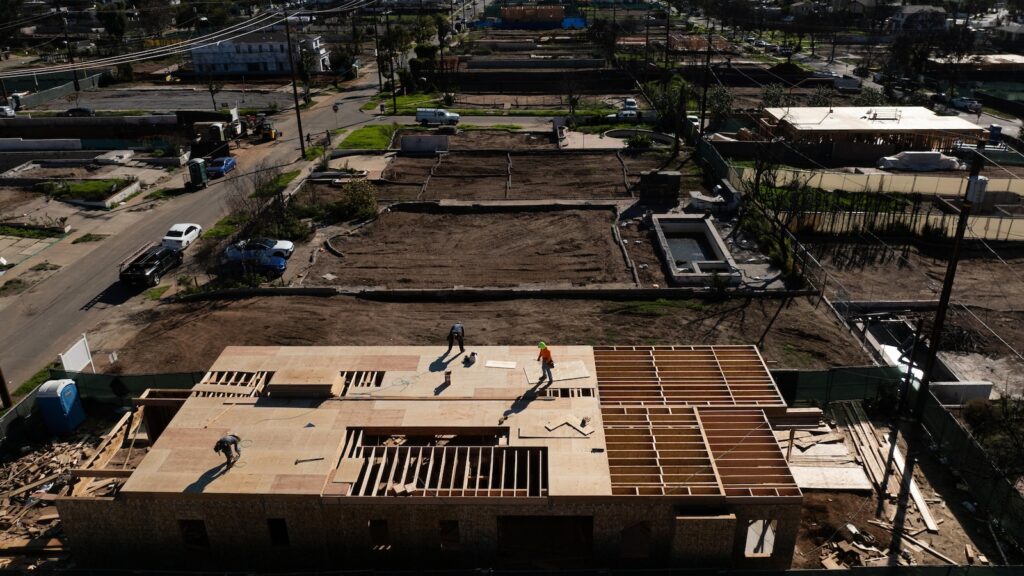
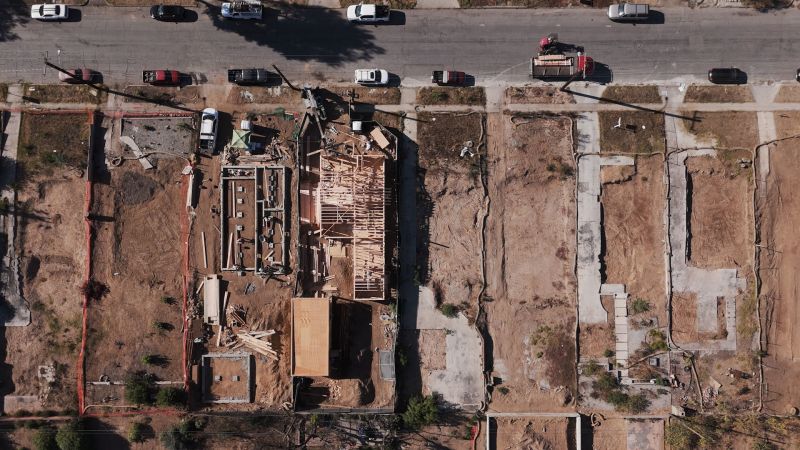
One year after a firestorm ripped through Sue Decker’s neighborhood in the foothills of Altadena, California, her street is still a barren vista of empty lots and piles of dirt where tidy bungalows once stood.
The block is hardly an outlier in Altadena, the Los Angeles-area neighborhood that went up in flames in January 2025 during the devastating Eaton Fire, which killed 19 people and destroyed or damaged more than 6,000 homes.
Fewer than a fifth of burned-out homes in Altadena have been issued rebuilding permits, county records show, let alone started construction. After an early rush of property sales, some homeowners have found themselves stuck, with dozens of lots languishing on the market for months.
Even as survivors of the fire here struggle to stay above water, they could face new hurdles to rebuilding.
Tariffs on lumber and cabinets imposed in the fall by President Donald Trump are expected to raise the costs of homebuilding. Immigration raids are reducing the labor pool for California’s construction industry. And after a state-imposed moratorium expires this week, some homeowners could be dropped by insurance companies that no longer want to take the risk of covering homes in fire zones.
The struggle is especially acute in Altadena, a historically diverse neighborhood that is less affluent than the coastal Pacific Palisades area that also burned down last January.
What’s happening in Altadena now could be a blueprint for the challenges facing disaster-ravaged towns around the country as fires and other calamities become more common. Trump’s policies and the perilous state of the property insurance industry are adding up to a perfect storm for people like Decker, who lost the home she lived in for more than two decades and has found herself overwhelmed by the difficulty of rebuilding her life.
Inside a local gymnasium at a community event for fire survivors this fall, surrounded by neighbors who had also lost their livelihoods, Decker broke into tears.
“There’s days where we just quit, I want to quit,” she said. “I’ll say, ‘You know what? I’m done. I’m done. I can’t do this anymore.’”

Two days after fires swept down out of the foothills, wiping out half of Altadena’s homes, Robert Lara stood outside the burned-out ruins of the house his family had owned for decades and wondered what to do.
“We have no clue where to start,” Lara told CNN on January 9, 2025.
He wasn’t alone in feeling uncertain about how to begin again. For decades, survivors of deadly natural disasters in California have faced steep challenges to rebuilding, like costly environmental remediation work and bureaucracy slowing building permit approvals.
But last year’s fires hit at the climax of a larger trend: A years-long collapse in the state’s home insurance industry.
In the wake of deadly fires in 2017 and 2018 in rural northern California, property insurers were faced with potentially staggering losses if fires tore through more densely populated suburbs in the future. As fires exacerbated by climate change became more common, some insurers stopped taking new customers or even dropped out of the state.
That’s left an increasing number of homeowners reliant on the California FAIR Plan, a last resort for those who can’t buy insurance elsewhere. The plan typically offers less coverage at higher rates.
The number of Californians on the FAIR Plan skyrocketed in recent years, including in zip codes in or near the Eaton fire zone, where policies grew more than a third from about 7,000 in 2023 to about 9,500 in 2024.
So as the fires roared through Altadena, thousands more homeowners were left with insurance coverage that didn’t fully cover the costs of rebuilding.
Lara was one of the luckier ones whose insurance wasn’t dependent on the FAIR Plan – but as he soon learned, that didn’t guarantee a quick route to rebuilding funds.
His insurance payout was smaller than he was hoping for, so Lara, who works as a general contractor, cut costs by managing the rebuild himself. He bought a trailer for the lot, where he lives amid blocks of ashen, empty properties.

A year after the fire, Lara has plans drawn and approved for a rebuilt home, but has yet to break ground. The process has been draining, he said.
“I wish I could stay in a nice place, and I didn’t have to go through this,” Lara said in an interview late last year. “You see yourself in a vacant lot, just a pile of dirt… I do understand why people would give up.”
Some of Lara’s neighbors could soon find themselves in an even tighter spot. That’s because January 7 marks the end of a year-long moratorium that had barred insurance companies from canceling or non-renewing residential policies in zip codes in and around the fire zones.
While other regulations prevent insurers from canceling coverage of homes that were totally destroyed at least until the primary structure is rebuilt, the moratorium’s end could lead to other nearby property owners losing insurance.
Madison Voss, a spokeswoman for the California Department of Insurance, said in a statement that the state agency has “not seen surges in non-renewals linked to the end of moratoriums” in past years.
But a spokesperson for State Farm, the state’s largest property insurance company, told CNN last month that because the moratorium was set to end, “unless there is a total loss, customers can expect non-renewal notices to resume around mid-January.”
It’s also possible that a new state policy allowing insurers to raise rates if they commit to insuring more homes in high-risk areas could increase coverage over time. But the rule includes a bevy of loopholes and, so far, has not led to significant numbers of new policies being signed.
Experts said that the larger problems plaguing the state’s insurance industry are making things harder for fire survivors – and all state residents facing the prospect of steeper premiums.
“You’ve got to worry about the liquidity of the system,” said Christopher Thornberg, the founding partner of Beacon Economics, a Los Angeles-based research and consulting firm. “The reason the cost of insuring homes has been going up is because the risks are rising, and the cost of rebuilding has been going through the roof.”

Fire survivors also face larger national trends threatening to make rebuilding more expensive – including the impact of Trump’s tariff and immigration policies.
Construction industry leaders have been ringing alarms about tariffs leading to higher construction costs for months. Prices for construction materials rose 3.5% from September 2024 to September 2025, according to an analysis of federal data by the Associated Builders and Contractors, a trade group.
The president’s tariffs on lumber, kitchen cabinets and furniture went into effect in mid-October, although Trump delayed further increases that were planned for this month until 2027.
Immigration raids have also threatened to cut into California’s construction workforce, which local experts say is already strained.
A report from the National Association of Home Builders found that 41% of construction workers in California were immigrants, the highest rate of any state in the United States. Another report from the Bay Area Council Economic Institute estimated that 14% of California’s overall construction workforce is undocumented, including more than one in every four construction laborers.
In June, Immigration and Customs Enforcement agents raided a construction site of a burned property in Altadena. Agents made no arrests, but half of the 12-man team working on the site stayed home the following day, stalling the construction process, a real estate agent representing the property’s developer told the Los Angeles Times.
Tim Kawahara, the executive director of UCLA’s Ziman Center of Real Estate, which has released reports on the rebuilding process, said the sum of those trends is hurting rebuilding efforts.
“It’s not a great time to have to rebuild,” said Kawahara, who grew up in Altadena. “Building materials would be impacted by tariffs. Labor markets are already incredibly tight here for construction in California, with the ICE raids… even people that are documented are scared to show up to work sites now.”
The biggest issue, Kawahara said, is the unpredictability plaguing the home construction industry and Altadena’s housing market.
“When you’re trying to build something like this, you just want certainty in the financial markets,” he said. “We just don’t have any certainty right now.”
Chris Hill is feeling that uncertainty every day. A 39-year-old tech worker, Hill bought his dream home with his wife in Altadena just two years before it burned down. Their insurance covered only a fraction of what it would cost to rebuild, and they still owe about $1.5 million on the mortgage for what is currently an empty lot.

Now, facing rising housing construction costs, Hill and his wife are scaling down plans for a full rebuild and considering a smaller manufactured house instead. In the meantime, they’re living in a rental home with donated furniture and closets full of free t-shirts from local volunteer events.
The experience has driven home the larger forces driving up housing costs, Hill said.
“You’re like, ‘Oh, well, those immigration policies don’t impact me directly. The tariffs don’t impact me in such a direct way,’” he said. “Until your house burns down. And then both of those things affect you in a very, very, very direct way.”
Before the fire, Hill said, the couple felt like they had finally secured their American dream: owning a home, having good-paying jobs, and knowing they had insurance if disaster struck.
“We did all the things that you’re supposed to do,” Hill said. Now, he added, it feels like they’re “starting from scratch.”

Fire survivors have faced another looming question: whether to rebuild in Altadena at all.
In the first weeks and months after the fire, some property owners reported receiving a barrage of offers to buy their burned-out lots. Corporate buyers – including several mid-size real estate companies and a firm started by a Powerball lottery winner who grew up in the area – have bought dozens of lots around Altadena.
Between February and mid-August, more than 35% of homes that were sold after being damaged or destroyed in the Eaton fire were bought by corporate investors, according to a CNN analysis of real estate records from the Los Angeles County Assessor. In comparison, only about a fourth of homes sold after being damaged or destroyed in the wealthier Palisades area, and fewer than 10% of all homes sold in Los Angeles County, were bought by corporate investors.
The corporate purchases have worried some locals who see outside investors as a threat to Altadena’s neighborhood character and its historic Black community. The area has a Black homeownership rate that is almost double the nation’s, according to 2023 data from the US Census Bureau’s American Community Survey.
“We had so many homeowners that told us that the day after the fire, they were receiving phone calls from developers interested in purchasing their parcels for pennies on the dollar,” said Jasmin Shupper, the founder of Greenline Housing Foundation, a racial justice real estate nonprofit that has been working to help homeowners of color stay in Altadena. “Investors are trying to come in and capitalize off of people’s grief.”

But some other property owners who would like to sell and move on are now struggling to do so, according to real estate data and realtors who work in the area. More than half of the active listed Altadena properties as of early November had been on the market for more than 60 days, according to data from the Multiple Listing Service.
Rene Wiebensohn, a local realtor, said that one burned-out Altadena property she was trying to sell had been on the market for more than 80 days – and as of late last year, “there’s not been a single bite.”
“In Altadena, purchasing vacant lots presents a huge swath of unknowns, which can be overwhelming for the average buyer,” Wiebensohn said.
Among the homeowners who sold early was Troy Laster, a retired LAPD officer who had lived 40 years in Altadena before his home burned down.
Laster loved waking up to mountain views in two directions and hosting barbecue parties with his neighbors that “jumped from house to house.” But he said the neighborhood he adored is now unrecognizable.
“This doesn’t feel like home,” Laster said. “It feels like somewhere else.”

In June, he sold his lot to Ocean Development, Inc., a California real estate company that had purchased at least 18 burned-out lots in Altadena as of mid-August, according to CNN’s analysis of county real estate data. The company, which didn’t respond to requests for comment, bought two other lots on the same block as Laster’s house.
“I wanted to do the best thing for the family to get back to normality, and I couldn’t wait for everything to be done,” Laster said.
Now, Laster lives 250 miles away from Altadena in a Las Vegas subdivision. He still makes the more than four-hour drive back to his old neighborhood to visit family and friends, but says he has no regrets.
His mortgage payment is the same as his old house, and he and his wife feel “at peace” living away from the trauma of the fire, Laster said.

Other survivors are determined to stay.
Lara, the general contractor, said he felt a responsibility to his family and community to stick out the difficult process.
His mother bought the Altadena house he grew up in 25 years ago – at a time when she was able to afford it with her salary as a hospital housekeeper – and Lara fondly remembers friends gathering to hang out around his family’s backyard pool.
Sitting by the shell of the pool on a recent afternoon, surrounded by empty lots and a handful of construction sites, Lara said that despite everything he’d lost, he felt a strong connection to the area.
“The physical stuff, the material things, are gone,” Lara said. “The memories are still there.”
Lara’s plans for his rebuilt house feature vaulted ceilings, a big kitchen island, and a large master suite – but he estimates the work will take another year at least. Until then, he’ll be living in his 500-square-foot trailer.
“I’m fighting for my land,” Lara said. “I’m not letting it go.”