The company reported better-than-expected iPhone sales and record third-quarter revenue, sending the stock up 2% in after-hours trading.
Here are the key numbers…
Revenue: $94.0 billion vs. estimates of $89.3 billion
Earnings per share: $1.57 vs. estimates of $1.43
iPhone revenue: $44.58 billion vs. estimates of $40.06 billion
Greater China revenue: $15.37 billion vs. estimate of $15.19 billion
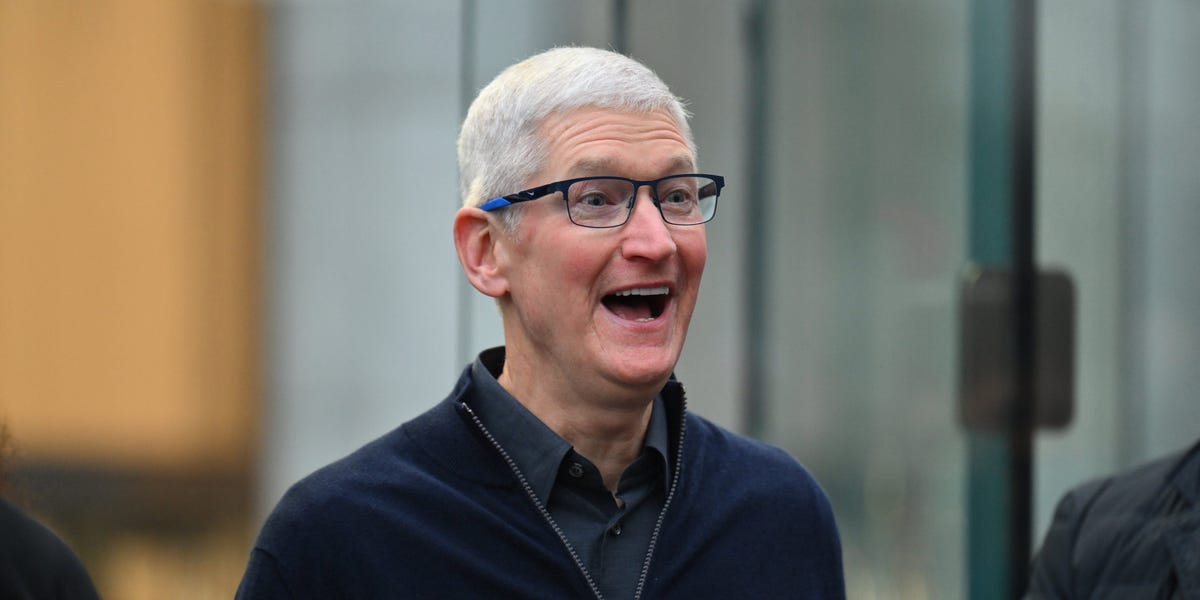
“Today Apple is proud to report a June quarter revenue record with double-digit growth in iPhone, Mac and Services and growth around the world, in every geographic segment,” said Tim Cook, Apple’s CEO.
Apple’s services revenue for the quarter reached an all-time high of $27.42 billion compared to estimates of $26.9 billion.
“Investors should not underestimate the fact that Apple delivered a massive revenue beat — and the biggest revenue growth in dollar terms since 2021 — in its slowest quarter of the year,”said Thomas Monteiro, senior analyst at Investing.com.
Apple stock is down 16% year-to-date, with tariff headwinds, iPhone demand, and a lack of a clear AI strategy compared to mega-cap peers weighing on the company.
Apple’s analyst call kicked off at 5 p.m. ET — follow along for the latest:
Apple touts its previously announced $500 billion US investment initiative.
Earlier this month, Apple announced a $500 million investment into MP Materials, a US-based company that works with rare earth materials. In August, it plans to launch Apple Manufacturing Academy in Detroit to help train and support American manufacturers.
Cook says Apple’s tariffs impact in the quarter was around $100 million less than expected.
Cook says that Apple recorded $800 million in tariff-related costs for the June quarter, about $100 million less than it warned investors of last quarter.
“We’re really proud of our results for the June quarter,” Cook says.
Looking ahead to the September quarter, Cook estimates a $1.1 billion tariff impact.
Cook takes a victory lap on Apple TV+ Emmy nominations.
Apple’s Services business in its fiscal Q3 hit a record high of $27.4 billion, while AppleTV+ scored 81 nominations for the Emmy Awards.
Cook shouts out its hit show “Severance,” which led the charge with 27 nominations. Today, Cook says, the platform has 585 wins under its belt.
Cook gives a quick update on the new AI Siri.
“We’re making good progress on a more personalized Siri, and as we’ve said before, we expect to release these features next year,” Cook says.
“We see AI as one of the most profound technologies of our lifetime,” he adds.
Tim Cook starts by saying Apple’s revenue growth was “better than we expected.”
“We saw an acceleration of growth around the world in the vast majority of markets we track, including Greater China and many emerging markets, and we had June quarter revenue records in more than two dozen countries and regions, including the US, Canada, Latin America, Western Europe, the Middle East, India and South Asia,” Cook says.
And we’re off! Apple’s earnings call begins.
CEO Tim Cook and CFO Kevan Parekh are on the call and will begin by reading through prepared remarks.
Apple faces fierce competition in China.
We’ll be looking closely at how Apple performed in China, where it’s faced sales pressure in recent years from local smartphone makers.
CEO Tim Cook has called China “the most competitive market in the world.” Apple competes against Huawei, Oppo, Xiaomi, and others in the region.
Wall Street analysts are expecting Greater China revenue of $15.19 billion.
Don’t be surprised if Tim Cook talks up Apple’s US investments, a recent trend on company earnings calls.
Apple has made multiple announcements around US investments since Donald Trump was re-elected.
The latest is the coming opening of the Apple Manufacturing Academy in Detroit.
“Beginning August 19, Apple, in partnership with Michigan State University, will host small and medium-sized businesses from across the country in Detroit for various workshops with Apple experts,” the company announced. “The courses are designed to help American companies transition to advanced manufacturing by implementing artificial intelligence and smart manufacturing techniques.”
Apple doesn’t disclose its salary info publicly. But to get a sense of what Apple can pay for various roles, the federal filings they make when hiring outside of the US can give clues to its pay ranges. While it’s not a complete picture, as the data only refers to foreign hires and doesn’t include equity or other benefits employees can receive on top of their base pay, it’s an interesting window into the company’s comp.
For example, Apple’s salary filings show a machine learning engineer or researcher can take home as much as $312,200, while a human interface designer can earn as much as $468,500.
Apple stock is about flat headed toward the earnings report
We’re about 30 minutes out from the closing bell, shortly after which Apple will report last quarter’s earnings.
Shares of Apple have been fairly flat today in the lead-up to the report, falling 0.17%. Over the last five trading days, the stock is down 2.73%.
If investors view the report positively, Apple could join the party started by Microsoft and Meta yesterday, both of which jumped at least 9% in after-hours trading after results were released.
Price hikes aren’t off the table for Apple
Customers trying out Apple’s iPhone 15 at an Apple store in Shanghai, China.
CFOTO/Future Publishing via Getty Images
In addition to further insight on AI strategy, analysts may be listening to the earnings call for clues on potential price increases. While Apple has held off on raising iPhone prices, Jefferies analysts expect the company to hike the price of some iPhone 17 models by $50 when the lineup is released to help cover tariff costs.
Jefferies assumes 40% of the iPhone 17 will be made in China for US consumers. If the average cost to build it goes up by $20 to $25, a $50 bump in price “may barely cover the above cost increases, the analysts wrote.
Other analysts, like EMARKETER’s Jacob Bourne, said iPhones could get more expensive depending on whether they’re made in China or India.
An American-made iPhone is virtually impossible, Business Insider’s Peter Kafka wrote. It certainly won’t happen without an astronomical boost in price, Wedbush Securities analyst Dan Ives previously said. He estimated that it could be priced at $3,500.
Not everyone is as worried about Apple’s AI strategy
Morgan Stanley analyst Erik Woodring doesn’t think AI is as crucial to Apple’s strategy as other analysts argue.
“We continue to believe that investors do not fully appreciate Apple’s AI intentions — most often comparing what Apple needs to do in AI with what META, GOOGL, AMZN, and others are doing,” Woodring said. “Of course, we acknowledge that Apple might not have fully finalized their own approach to AI, but we also believe that anyone thinking Apple will acquire an AI-powered search engine to ‘solve their AI shortfalls’ is misguided.”
He continued: “We recognize the uncertainty around AI means Apple is not near the top of the “AI Beneficiaries” pecking order today, but Apple’s core business (selling products and services) is not materially threatened by AI in the near term, and as a result, Apple still has time to right the AI ship.”
Morgan Stanley still has an “Overweight” rating on the stock with a price target of $235.
“Watching this 4th Industrial Revolution race go by at 100 miles an hour”
Apple CEO Tim Cook speaks before the start of the Apple Worldwide Developers Conference at its headquarters in Cupertino, California.
Justin Sullivan/Getty Images
Wedbush’s Dan Ives is another analyst who sees quick progress on AI as crucial for Apple. He said the firm is in danger of falling permanently behind in the AI race if it doesn’t change course soon.
“In the AI Revolution there is an arms race going on between Big Tech stalwarts Nvidia, Microsoft, Alphabet, Amazon, Meta, OpenAI, Oracle and many others to monetize the biggest tech trend in the last 50 years…..while Apple is at a highway rest stop on a bench watching this 4th Industrial Revolution race go by at 100 miles an hour,” Ives wrote earlier this month.
Ives said Apple should jump on the Perplexity deal and that if it acts quickly, the company can still catch up to competitors. He said such a move would be a “no-brainer” for Apple.
Wedbush has a $270 price target for Apple stock.
The stakes are high after Wall Street was underwhelmed by Apple’s developers conference
After setbacks and delays to its expected AI-driven Siri, Wall Street was eager to hear at WWDC 2025 about the company’s plans to stay competitive in the AI arms race.
While Apple did introduce some new Apple Intelligence features, like AI-powered personalized shortcuts on Mac, it also reiterated that it “needed more time to reach our high-quality bar” and more will be launched in the coming year.
The keynote mainly focused on “Liquid Glass,” a glass-like software design coming to Apple’s gadget lineup this fall.
Watch for updates on Apple’s AI strategy
Getty/NurPhoto
Investors think Apple is behind on its AI efforts and will be watching to see if CEO Tim Cook signals any shifts in strategy.
Melius Research analyst Ben Reitzes said to listen for potential updates on the rumored possibility that Apple buys Perplexity AI to help with its upgrade of Siri.
Such a move could send the share price soaring, he said, as the company looks for ways to make its products’ interface smoother for users.
“It does feel like the market would reward Apple for being bolder, which could result in several hundreds of billions in value,” Reitzes wrote in a July 21 note.
Melius has a $240 price target on Apple stock.
Apple is taking a look at its supply chain to deal with tariff-related costs
President Donald Trump’s demand for American-made iPhones has become a tariff headache for Apple. To avoid hefty tariff costs from manufacturing in China, the tech giant is ramping up production in India to make more US iPhones outside the region it once heavily relied on.
Smartphones assembled in India made up 44% of US imports in Q2, a jump from the 13% during the same period in 2024, research firm Canalys estimated in an analysis published on Monday.
“For the June quarter, we do expect the majority of iPhones sold in the US will have India as their country of origin,” CEO Tim Cook said during the May 1 earnings call.
The iPhone maker is also looking for American options for its supply chain. On July 15, it announced a $500 million investment in MP Materials, a US producer of rare earth magnets. The deal was a part of Apple’s initiative to spend $500 billion in the US over the next four years.
How is the trade war affecting profits?
An Apple Store in Shanghai, China.
CFOTO/Future Publishing via Getty Images
In a note earlier this week, Bank of America said its clients would be most interested in Apple’s Q2 and future estimated profit margins for clues about how the company, with its sprawling global supply chains, will be able to navigate the trade war.
BofA analyst Wamsi Mohan says tariffs should have a “meaningful negative impact” on Apple’s profits.
One thing that could counteract a hit to margins, however, is the release of a slimmer iPhone, Mohan said. The company could announce the product, which they would likely sell for a higher price than previous iPhones, in September.
“We expect the slim iPhone to replace the Plus model from last year and be priced $100 higher vs the Plus model,” Mohan wrote.
BofA has a “Buy” rating on Apple stock, and expects it to climb to $235 a share within the next 12 months.
Apple earnings estimates: Wall Street expects $89.3 billion of revenue, $1.43 of EPS
Third quarter
Revenue estimate $89.3 billion
EPS estimate $1.43
Products revenue estimate $62.81 billion
IPhone revenue estimate $40.06 billion
Mac revenue estimate $7.3 billion
IPad revenue estimate $7.07 billion
Wearables, home and accessories estimate $7.78 billion