Asian stock markets plunge, gold reaches record high
Gold has reached a record high while the yen has strengthened against the dollar and stock markets have slumped after Donald’s Trump’s unexpectedly aggressive tariff announcement. Here’s the latest on the markets courtesy of Reuters:
The high-flying tech sector was pummelled as manufacturing hubs in China and Taiwan faced new tariffs above 30%, bringing the total new levy to an eye-watering 54% on imports from China.
“The US effective tariff rate on all imports look to be the highest level in over a century,” said Citi’s global rates trading strategist, Ben Wiltshire.
Nasdaq futures tumbled 4% and in after-hours trade some $760 billion was wiped from the market value of Magnificent Seven technology leaders. Apple shares, hit hardest as the company makes iPhones in China, were down nearly 7%.
S&P 500 futures fell 3.3%, FTSE futures fell 1.8%, while European futures fell nearly 2%.
Gold hit a record high above $3,160 an ounce, and oil, a proxy for global growth, slumped more than 3% to put benchmark Brent futures at $72.56 a barrel.
In early trade in Tokyo, the Nikkei was down 3.9% at an eight-month low, with nearly every index member falling as shippers, banks, insurers and exporters copped a beating.
Benchmark 10-year Treasury yields shot down 14 basis points to a five-month low of 4.04% as investors braced for slower US growth, while interest rate futures priced in a higher chance of interest rate cuts in the months ahead.
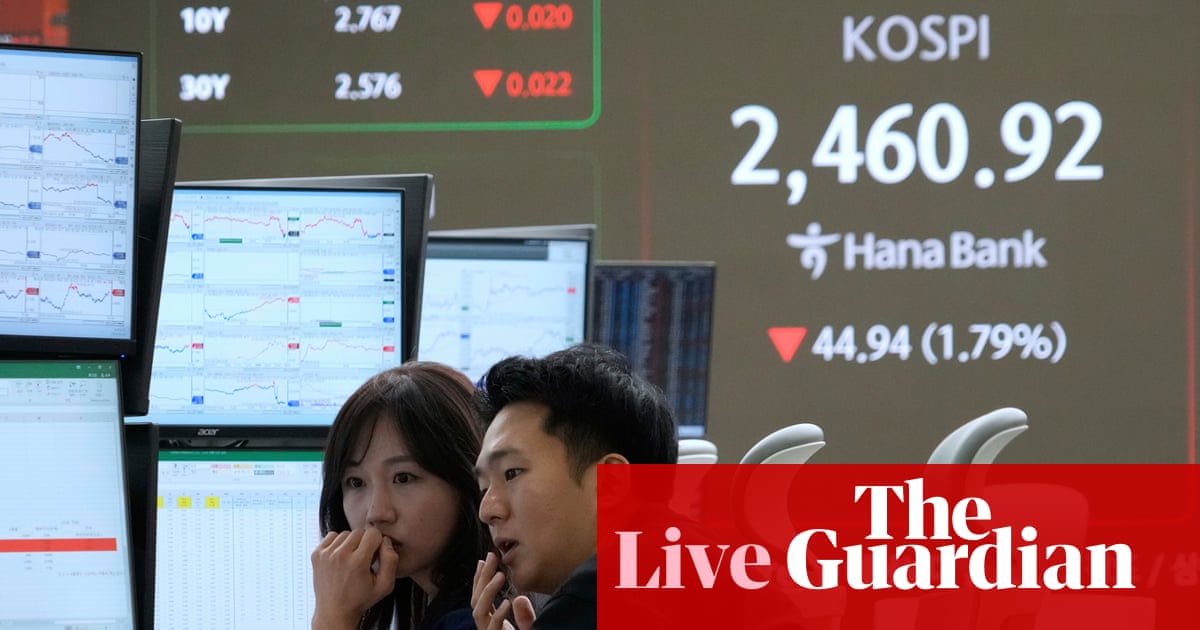
South Korea’s Kospi fell 2%. Van Eck’s Vietnam ETF fell more than 8% in after-hours trade. Australian shares fell 2%.
Markets in Taiwan were closed for a holiday.
Us President Donald Trump appears on a television screen at the stock market in Frankfurt, Germany. Photograph: Michael Probst/AP
China’s yuan touched a two-month low in offshore trade, ahead of the onshore open.
Ten-year Japanese government bond futures made their sharpest jump in eight months.
Key events
US tariffs a ‘major blow’ to world economy, EU preparing counter measures, von der Leyen says
US tariffs are a “major blow” to the world economy and the EU is preparing counter measures that will apply if negotiations fail, EU Commission chief Ursula von der Leyen has said.
“We are already finalising the first package of countermeasures in response to tariffs on steel,” she said in a statement read out in Uzbekistan ahead of an EU-Central Asia partnership summit.
“And we’re now preparing for further countermeasures to protect our interests and our businesses if negotiations fail.”
Trump earlier unveiled a 10% minimum tariff on most goods imported to the US with a higher 20% rate for the EU.
Shares in Hanoi have also plunged by more than 5% after markets opened on Thursday; Trump hit Vietnam with particularly harsh tariffs of 46%.
The Hanoi Stock Exchange Equity Index sank 5.6 percent, or 13.42 points, to 224.71.
US tariffs are ‘extremely regrettable’ and will hurt US economy, Japan says
Japan’s trade minister says Tokyo told Washington that sweeping new US tariffs that include a 24% levy on Japanese imports are “extremely regrettable”, according to AFP.
“I have conveyed that the unilateral tariff measures taken by the US are extremely regrettable, and I have again strongly urged [Washington] not to apply them to Japan,” Yoji Muto told reporters, adding that he spoke with US commerce secretary Howard Lutnick before Donald Trump’s announcement.
Japan’s trade minister Yoji Muto. Photograph: Xinhua/REX/Shutterstock
“I also explained in detail how the US tariffs would adversely affect the US economy by undermining the capacity of Japanese companies to invest in the United States,” said Muto.
“We had a frank discussion on how to pursue cooperation in the interest of both Japan and the United States that does not rely on tariffs,” Muto said.
Chief cabinet secretary Yoshimasa Hayashi also told reporters that the tariffs may contravene World Trade Organization (WTO) rules and the two countries’ trade treaty.
“We have serious concerns as to consistency with the WTO agreement and Japan-US trade agreement,” he told reporters.
Japan has also failed to win exclusion from 25-percent tariffs on auto imports due to come into force later on Thursday.
Last year, vehicles accounted for around 28% of Japan’s 21.3 trillion yen ($142 bn) of US-bound exports, and roughly eight% of all Japanese jobs are tied to the sector.
China urges US to ‘immediately cancel’ new tariffs, calls for ‘dialogue’
China’s commerce ministry has called for Washington to “immediately cancel” sweeping new tariffs, warning they “endanger global economic development” and would hurt US interests and international supply chains.
“China urges the US to immediately cancel unilateral tariff measures and properly resolve differences with trade partners through equal dialogue,” the ministry said, adding: “There is no winner in a trade war, and there is no way out for protectionism.”
Trump has hit China with particularly stinging tariffs of 34% in addition to already existing 20% tariffs on all Chinese imports.
Beijing also accused the United States of a “typical unilateral bullying practice”.
Trump has said his tariffs are “reciprocal” but many experts say his administration’s estimates for levies placed on US imports by other countries are wildly exaggerated.
“The US claims to have suffered losses in international trade, using so-called ’reciprocity’ as an excuse to raise tariffs on all trade partners,” Beijing said.
“This approach disregards the balance of interests achieved through years of multilateral trade negotiations and ignores the fact that the US has long profited significantly from international trade,” it added.
‘Nowhere on earth is safe’: Trump imposes tariffs on uninhabited islands near Antarctica
Kate Lyons
In news you didn’t know you needed:
A group of barren, uninhabited volcanic islands near Antarctica, covered in glaciers and home to penguins, have been swept up in Donald Trump’s trade war, as the US president hit them with a 10% tariff on goods.
A handout photo taken on November 21, 2012 and released on 8 October, 2024 by the Australian Antarctic Division shows a waddle of King penguins standing on the shores of Corinthian Bay in the Australian territory of Heard Island in the Southern Ocean. Photograph: Matt Curnock/AUSTRALIAN ANTARCTIC DIVISION/AFP/Getty Images
Heard Island and McDonald Islands, which form an external territory of Australia, are among the remotest places on earth, accessible only via a two-week boat voyage from Perth on Australia’s west coast. They are completely uninhabited, with the last visit from people believed to be nearly 10 years ago.
Nevertheless, Heard and McDonald Islands featured in a list released by the White House of countries that would have new trade tariffs imposed.
Read the full story below.
Kate Lamb
Developing nations in South-east Asia, including war-torn and earthquake-hit Myanmar, and several African nations are among the trading partners facing the highest tariffs set by US President Donald Trump’s sweeping tariffs.
Cambodia, a developing economy where 17.8% of the population live below the poverty line according to the Asian Development Bank (ADB), is the worst-hit country in the region with a tariff rate of 49%.
In second place is the landlocked South-east Asian nation of Laos, a country heavily bombed by the US during the cold war, with 48%. According to the ADB, Laos has a poverty rate of 18.3%.
But the real target may be China.
“The administration thinks is that by targeting these countries they can target Chinese investment in countries like Cambodia, Laos, Myanmar, Indonesia,” said Dr Siwage Dharma Negara, a senior fellow at the ISEAS-Yusof Ishak Institute in Singapore. “By targeting their products maybe it will effect Chinese exports and the economy.”
“The real target is China but the real impact on those countries will be quite significant because this investment creates jobs and export revenue.”
Markets have now opened in China and stocks are sinking there too. The Hang Seng Index in Hong Kong dropped 2.43%, or 564.32 points, to 22,638.21, while in mainland China the Shanghai Composite Index shed 0.91%, or 30.52 points, to 3,319.61.
China has been hit with tariffs of 34% in addition to already existing tariffs of 20% on all Chinese imports.
US treasury secretary Scott Bessent has urged other countries to not retaliate.
“Let’s see where this goes, because if you retaliate, that’s how we get escalation,” Bessent told CNN. “Doing anything rash would be unwise,” he added. When asked how he expected US stock markets to react to the tariffs he said: “I don’t know.” He continued:
What’s going to be important are the underlying economic fundamentals, because at the end of the day, Warren Buffett says, in the short run, the market is a voting machine. In the long run, it’s a weighing machine.
He acknowledged that prices could go up but said“they don’t have to.”
Photograph: Kent Nishimura/EPA
Canadian exemption from tariffs ‘like dodging a bullet into the path of a tank’
Leyland Cecco
Canada’s exemption from Donald Trump’s global tariffs was “like dodging a bullet into the path of a tank”, say business leaders as other levies are poised to hit key industries that drive the country’s economy.
In a theatrical unveiling of tariffs on countries with “unfair” practices on Wednesday afternoon, Canada was noticeably absent, alongside trade ally Mexico.
But speaking speaking to reporters on Parliament Hill, prime minister Mark Carney said 25% tariffs on Canadian steel and aluminum, as well as on automobiles, will come into effect within hours.
Photograph: Patrick Doyle/Reuters
Canada would “fight these measures with countermeasures” he said, ahead of a meeting with cabinet ministers. “In a crisis, it’s important to come together. It’s essential to act with purpose and with force and that’s what we’ll do.”
Already, Canada had put a 25% tax on C$30bn ($21bn) worth of US goods in response to Trump’s tariffs. Among the products targeted are spirits, wine and orange juice – items meant to inflict targeted economic pain. The federal government has repeatedly pledged to keep its retaliatory measures until the US lifts all levies on Canadian products.
The prime minister is expected to outline the next stages of Canada’s response on Thursday.
Flavio Volpe, president of the Automotive Parts Manufacturers’ Association posted on social media the result was “like dodging a bullet into the path of a tank”.
Republican senators join Democrats to block tariffs on Canada
Lauren Gambino
Several Republican senators have joined Democrats to pass a resolution that would block Donald Trump’s tariffs on Canada, a rare rebuke of the president’s trade policy just hours after he announced plans for sweeping import taxes on some of the country’s largest trading partners.
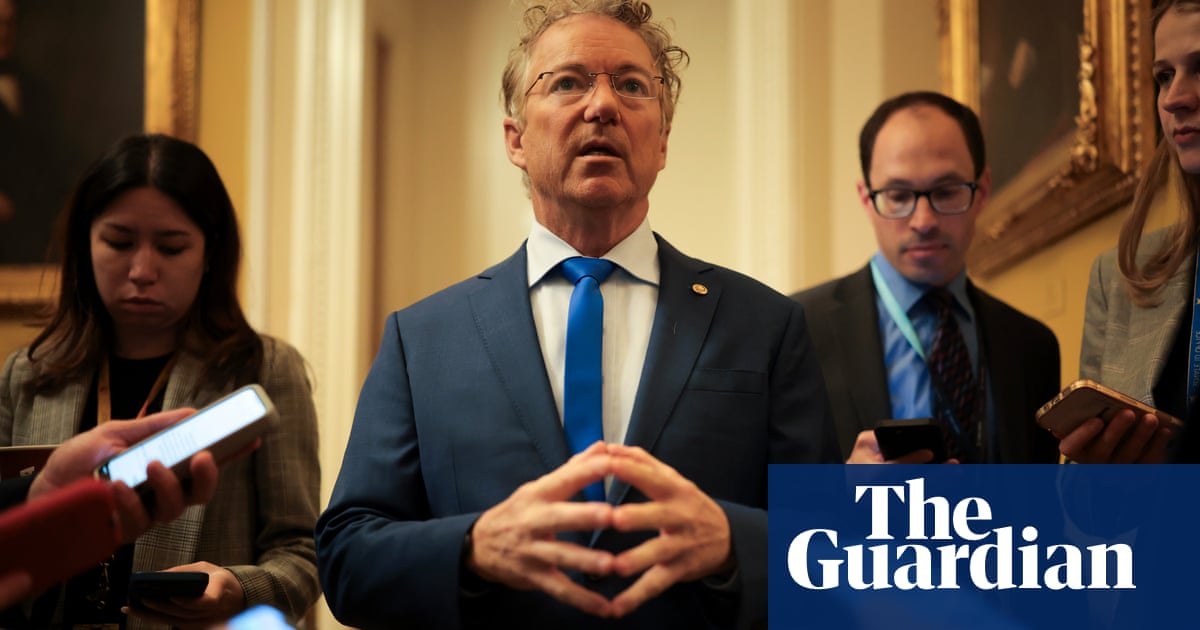
In a 51-48 vote, four Republicans – Susan Collins of Maine, Lisa Murkowski of Alaska, and both Kentucky senators, the former majority leader Mitch McConnell and Rand Paul – defied Trump’s pressure campaign and supported the measure.
Democrats used a procedural maneuver to force a vote on the resolution, which would terminate the national emergency on fentanyl Trump is using to justify tariffs on Canada.
While Trump’s sweeping new tariffs, introduced in a White House Rose Garden ceremony on Wednesday, did not include additional levies on Canada, the Senate vote amounted to a significant bipartisan condemnation of the president’s escalating global trade war with allies and enemies alike.
“Tariffs will hurt our families. Canada is not an enemy,” the Democratic senator Tim Kaine, the bill’s sponsor, said in a floor speech on Wednesday.
Let’s not label an ally as an enemy. Let’s not impose punishing costs on American families at a time they can’t afford it. Let’s not hurt American small businesses. Let’s not make our national security investments in ships and subs more expensive.
Krishani Dhanji
A bit more from Australian prime minister Anthony Albanese, who has said the latest move by the Trump administration has not come as a surprise, and that the tariffs were “not unexpected”. But he has reiterated that the tariffs are unwarranted:
President Trump referred to reciprocal tariffs. A reciprocal tariff would be zero, not 10%. The administration’s tariffs have no basis in logic and they go against the basis of our two nations’ partnership. This is not the act of a friend.
He also said the move will have consequences for how Australians see their relationship with the US.
The Australian people have every right to view this action by the Trump administration as undermining our free and fair trading relationship and counter to the shared values that have always been at the heart of our two nations’ longstanding friendship.
This will have consequences for how Australians see this relationship.
Photograph: Lukas Coch/EPA
Asian stock markets plunge, gold reaches record high
Gold has reached a record high while the yen has strengthened against the dollar and stock markets have slumped after Donald’s Trump’s unexpectedly aggressive tariff announcement. Here’s the latest on the markets courtesy of Reuters:
The high-flying tech sector was pummelled as manufacturing hubs in China and Taiwan faced new tariffs above 30%, bringing the total new levy to an eye-watering 54% on imports from China.
“The US effective tariff rate on all imports look to be the highest level in over a century,” said Citi’s global rates trading strategist, Ben Wiltshire.
Nasdaq futures tumbled 4% and in after-hours trade some $760 billion was wiped from the market value of Magnificent Seven technology leaders. Apple shares, hit hardest as the company makes iPhones in China, were down nearly 7%.
S&P 500 futures fell 3.3%, FTSE futures fell 1.8%, while European futures fell nearly 2%.
Gold hit a record high above $3,160 an ounce, and oil, a proxy for global growth, slumped more than 3% to put benchmark Brent futures at $72.56 a barrel.
In early trade in Tokyo, the Nikkei was down 3.9% at an eight-month low, with nearly every index member falling as shippers, banks, insurers and exporters copped a beating.
Benchmark 10-year Treasury yields shot down 14 basis points to a five-month low of 4.04% as investors braced for slower US growth, while interest rate futures priced in a higher chance of interest rate cuts in the months ahead.
South Korea’s Kospi fell 2%. Van Eck’s Vietnam ETF fell more than 8% in after-hours trade. Australian shares fell 2%.
Markets in Taiwan were closed for a holiday.
Us President Donald Trump appears on a television screen at the stock market in Frankfurt, Germany. Photograph: Michael Probst/AP
China’s yuan touched a two-month low in offshore trade, ahead of the onshore open.
Ten-year Japanese government bond futures made their sharpest jump in eight months.
Analysis: Trump’s wall of tariffs likely to exacerbate economic slowdown
Heather Stewart
Donald Trump is finally making good on his campaign promises to “build that wall” – but instead of steel fencing along the Mexican border, it will be constructed from tariffs, and will enclose the entire United States.
In his pugnacious and typically rambling speech on the White House lawn on Wednesday, Trump set out plans for across-the-board import taxes, ranging from 10% to more than 40%.
The president promised “liberation”, yet the immediate impact is more likely to be rising prices for US shoppers and corrosive uncertainty for firms, exacerbating an economic slowdown that may already be under way.
Outside the wall, countries will be affected according to how dependent their economies are on exports to the US – and how exposed they are to the global trading system. For some, it is likely to be devastating.
The precise effects of sweeping tariffs on this historic scale are hard to predict. One factor is how rival economies will respond: retaliatory tariffs tend to make a bad situation worse, though they may make short-term political sense (see Mark Carney’s poll ratings in Canada).
Another question is whether the dollar may appreciate, somewhat softening the blow for US importers. That may limit the effect on prices, which would otherwise be expected to rise as the cost of importing products and materials increases.
The main challenge in assessing the exact impact of the plans, though, is that Trump’s statement did not mark the end of the period of profound economic uncertainty that began when he arrived in the White House – quite the opposite.
Krishani Dhanji
Australian prime minister Anthony Albanese has voiced confusion about the tariffs levied on Norfolk Island, which is an Australian territory.
“I think Norfolk Island somehow has been hit with 29% tariff rather than 10%. Last time I looked, Norfolk Island was a part of Australia,” he told ABC Radio Melbourne.
Later at a press conference, he added:
I’m not quite sure that Norfolk Island, with respect to it, is a trade competitor with the giant economy of the United States but that just shows and exemplifies the fact that nowhere on earth is exempt from this.
The tariffs raised on Australia are 10%; those levied on Christmas Island (an external territory of the country) are also 10%. While those aimed at Norfolk Island (another external territory) stand at 29%.
South Korea says it will use ‘all its capabilities’ to overcome trade crisis
South Korea’s acting President Han Duck-soo has ordered emergency support measures for businesses that will be affected by the imposition of US tariffs of 25%, including automobiles, the industry ministry has said.
Han asked the industry minister to analyse the content of the tariffs and actively negotiate with Washington to minimise the impact of US reciprocal tariffs, the ministry said. Han said:
As the global trade war has become a reality, the government must pour all its capabilities to overcome the trade crisis.
Trump in his speech singled out Washington’s Asian security allies South Korea and Japan, accusing them of being among the worst offenders for conducting unfair trade practices against the United States.
Finance minister Choi Sang-mok and industry minister Ahn Duk-geun are to hold further meetings later on Thursday to discuss the tariffs’ impact on financial and foreign exchange markets, strategies for outreach to the US and the response of government and business, the news agency Yonhap reported.
Analysts in Seoul said Trump’s extensive rollout of tariffs was harsher than expected, casting a cloud over the export-reliant economy.
“For the domestic economy, a significant blow will be inevitable,” said Park Sang-hyun, an economist at iM Securities.
“It is clear that major export products such as automobiles will be hit hard, and exports to the US through production bases in Vietnam will also be hit hard,” Park said in a note.