Now Reading: Scientists Thought Saturn’s Moon Titan Hid a Secret Ocean. They Were Wrong
-
01
Scientists Thought Saturn’s Moon Titan Hid a Secret Ocean. They Were Wrong
Scientists Thought Saturn’s Moon Titan Hid a Secret Ocean. They Were Wrong

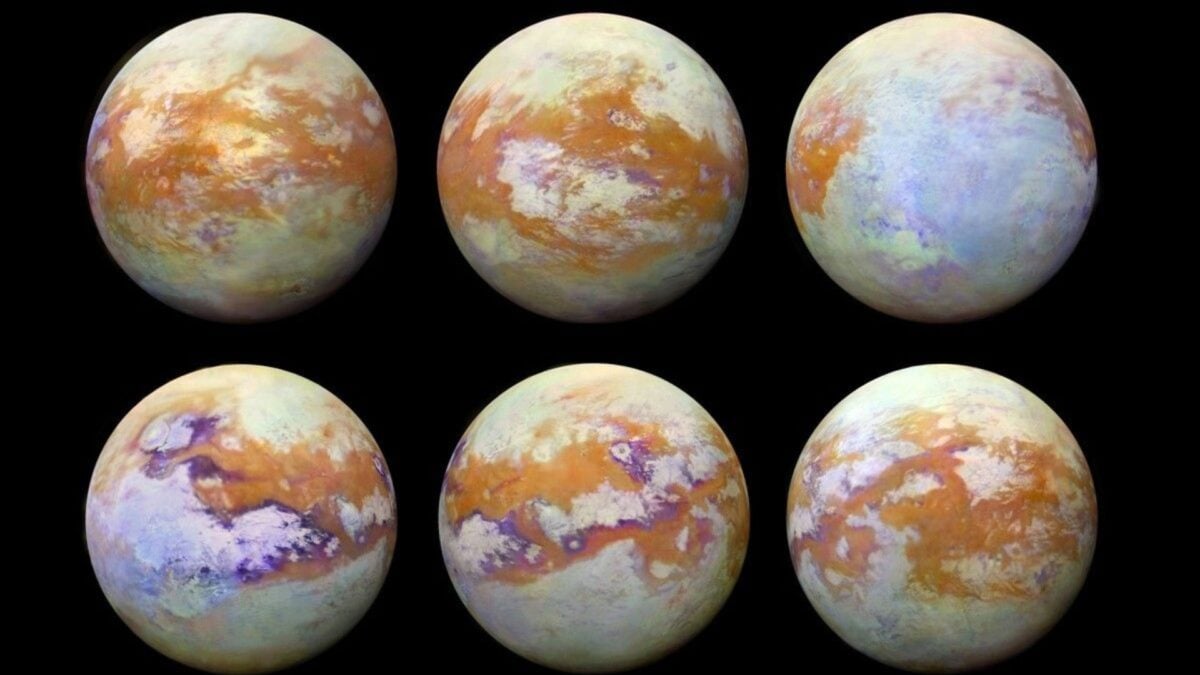
Over a decade ago, NASA’s Cassini spacecraft found evidence of a vast ocean of liquid water beneath the frozen surface of Titan, Saturn’s largest moon. A fresh analysis of that same data paints a completely different picture of Titan’s interior.
The study, published Wednesday in the journal Nature, found that Titan does not, in fact, contain a subsurface ocean. Rather, its 6-mile-thick (10-kilometer-thick) crust of ice gives way to a layer of slush interspersed with pockets and channels of meltwater near the moon’s rocky core. The shocking findings could completely change the way scientists search for signs of life inside this icy world.
“I was introduced to the planetary science world just a few years ago, and I had always taken for granted that Titan has an ocean,” lead author Flavio Petricca, a postdoctoral fellow at NASA’s Jet Propulsion Laboratory, told Gizmodo in an email.
“While working on this and elaborating these ideas, it happened very often that I woke up very early in the morning because I couldn’t believe what I was seeing in the data, that Titan might not have an ocean,” he said.
Cassini’s case for a subsurface ocean
NASA’s Cassini spacecraft launched in October 1997, embarking on a seven-year journey through the solar system. The spacecraft had its first close encounter with Titan in October 2004, coming within 750 miles (1,200 kilometers) of the moon’s icy surface to skim its hazy atmosphere.
In December of that year, Cassini deployed the Huygens probe, which touched down on the surface of Titan three weeks later. The spacecraft gathered data on the moon’s atmosphere during its 27-minute descent, then survived another 72 minutes on the ground. The images it captured during that brief window revealed that Titan has Earth-like meteorology and geology.
Cassini went on to complete 124 flybys of Titan. The mountain of data it gathered included radar and gravity measurements that led scientists to believe the moon is hiding a huge ocean of liquid water and ammonia beneath its crust. Huygens also measured radio signals that corroborated this idea.
The discovery made waves throughout the scientific community, encouraging researchers to search for evidence of Titan’s potential habitability. Over the past decade, the idea that Titan harbors a vast underground reservoir of liquid water became widely accepted, but there was always one nagging problem. When researchers modeled the moon with a subsurface ocean, the results didn’t actually match the physical properties described by the Cassini data.
Now, Petricca and his colleagues have proposed an alternative explanation for Titan’s unusual gravity field and geophysical measurements. Perhaps there isn’t a liquid ocean beneath the moon’s surface but rather a vast reservoir of slush.
Revisiting Titan from afar
As Titan orbits Saturn, the ringed planet’s gravity tugs on the moon. These gravitational “tides” deform Titan’s surface, creating bulges that point toward Saturn. If Titan were composed entirely of solid rock, Saturn’s gravitational attraction would produce bulges only 3 feet (1 meter) high, but the Cassini data showed that they’re actually much larger.
This suggested that Titan is not solid all the way through to its core, leading scientists to assume the moon has a subsurface ocean. “On the other hand, a layer of slushy ice with widespread melt pockets can also lead to strong deformations,” Petricca explained.
If Titan had a liquid ocean beneath its crust, the surface would respond immediately to Saturn’s gravitational pull. “Imagine standing on the surface and Saturn passing above your head. The surface below your feet would rise, and that bulge would closely follow Saturn,” Petricca said.

If instead there is a layer of slush with pockets of meltwater, that would cause tidal dissipation in the interior, creating a delay between Saturn’s gravitational influence and Titan’s bulge response, according to Petricca. This delay had never been measured before, but his team reanalyzed the Cassini data with improved processing techniques and found a signature of a 15-hour delay in Titan’s gravity field.
The finding shocked Petricca and his colleagues. “I’ve never seen someone doubting the result that much,” co-author Baptiste Journaux, an assistant professor of Earth and space sciences at the University of Washington, said of Petricca.
“He spent months and months and months staring at it, re-checking everything, getting critical feedback from some of the top researchers in the world to make sure that he was not making any mistakes,” Journaux told Gizmodo. But there was no error—the results strongly suggested that a layer of slushy, high-pressure ice sits between Titan’s core and its frozen crust.
Rethinking the search for life on Titan
The findings offer a revelatory new view of Titan’s structure and processes, and suggest that its potentially habitable environment may look very different than scientists previously thought.
“We went from looking for an open ocean type of ecosystem to something that’s probably going to be much more like sea ice or aquifers,” Journaux said. “Because we don’t have an open ocean, I think even just the signatures of life will be different.”
This basically changes everything about the way researchers will hunt for signs of life on Titan. The tools, strategies, regions of interest, and clues will all be different, according to Journaux. While this presents an enormous challenge, “I think that our new results make Titan more interesting,” Petricca said.
“Our models indicate that there should be pockets of liquid warm water, with temperatures up to [68 degrees Fahrenheit (20 degrees Celsius)], cycling nutrients from the moon’s rocky core, through slushy layers of warm ice, to a solid icy shell at the surface,” he explained. “This might have strong implications for the habitability potential of Titan, but I should emphasize that our study did not look into these.”
Both Petricca and Journaux hope their findings will pave the way for habitability studies that are better suited to the moon’s slushy subsurface environment. Nearly three decades after Cassini’s launch, it appears a new era of Titan exploration is just beginning.
Related Posts


Stay Informed With the Latest & Most Important News










Advertisement