Now Reading: Stock market today: Live updates
-
01
Stock market today: Live updates

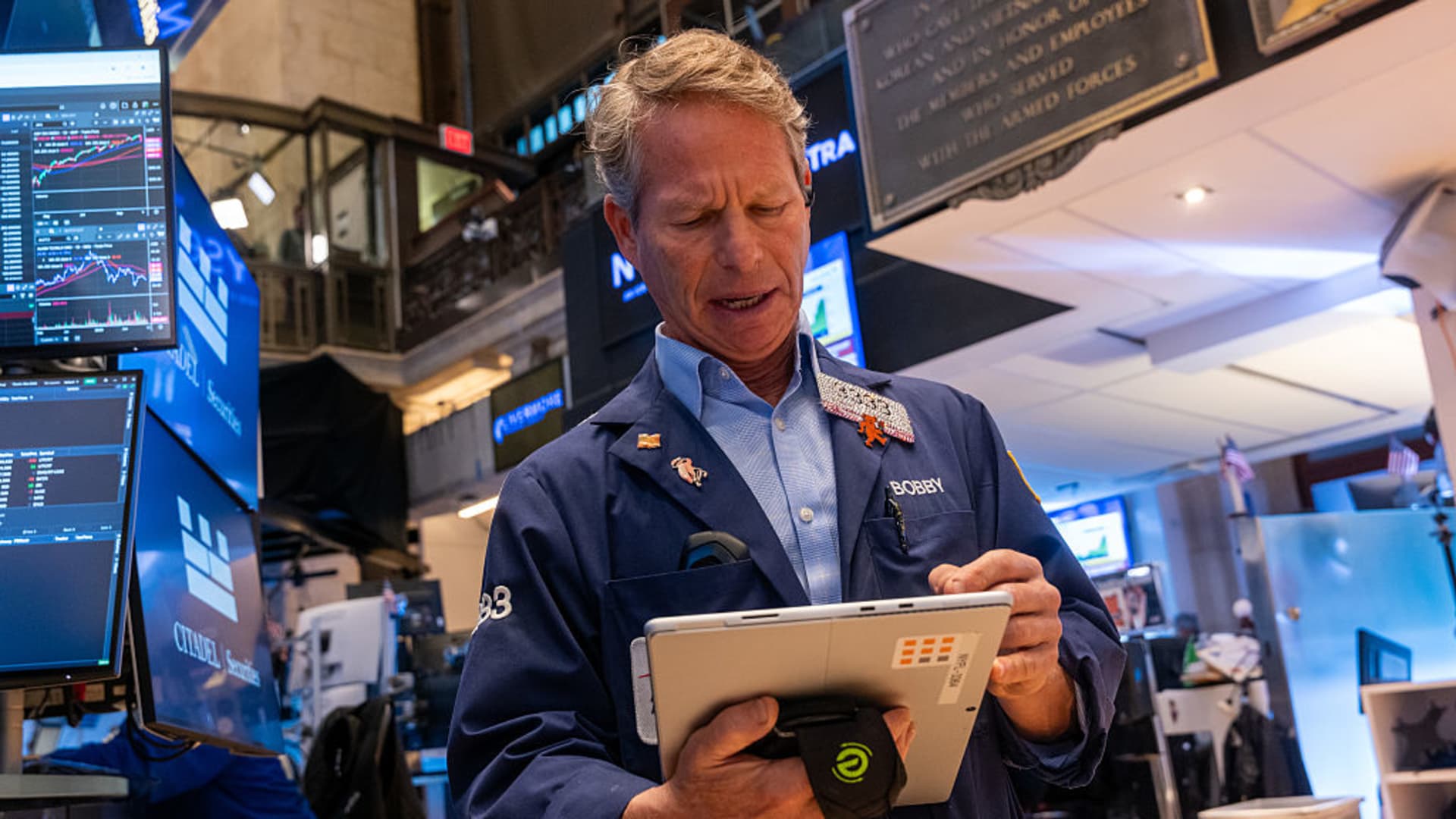
Traders work on the floor of the New York Stock Exchange (NYSE) on October 13, 2025, in New York City.
Spencer Platt | Getty Images
Stocks reversed course on Wednesday, giving up earlier gains, as volatility continued to engulf Wall Street.
The Dow Jones Industrial Average was last down 109 points, or 0.3%, after rising as much as 422.88 points. The S&P 500 traded 0.1% lower after gaining as much as 1.2%. The Nasdaq Composite hovered around the flatline. It briefly rallied as much as 1.4%.
The Cboe Volatility Index (VIX), known to many as Wall Street’s fear gauge, perked higher in afternoon trading. It was last at 22.7.

Dow intraday
Bank of America shares jumped 4% after the company posted third-quarter earnings and revenue that beat analyst expectations, thanks to strong investment banking revenue. Morgan Stanley also posted better-than-expected earnings, sending its shares higher by 6%.
Those results come after a spate of better-than-expected reports from Goldman Sachs and Wells Fargo, among others, on Tuesday.
“It appears as if the banks have hit the ball out of the park, exceeding both earnings and revenue expectations,” Sam Stovall Chief Investment Strategist at CFRA Research, told CNBC. “That’s an indication that the economy remains strong and, coupled with the likelihood that the Fed will cut rates again at the end of this month, [it] is bolstering investor optimism.”
The period of renewed investor optimism comes after a tumultuous session on Tuesday. The S&P 500 attempted a comeback but ultimately closed lower after President Donald Trump threatened China with a cooking oil embargo late in the session as retaliation for Beijing not buying U.S. soybeans. Earlier, Trump also threatened to place additional 100% tariff on any goods coming from China in response to Beijing imposing strict export controls on rare earth minerals.
Recent stock market volatility stoked by the trade war hasn’t discouraged federal officials from pursuing tough talks with China, Treasury secretary Scott Bessent said Wednesday.
“We won’t negotiate because the stock market is going down,” Bessent said in an exclusive interview at CNBC’s Invest in America Forum. “We will negotiate because we are doing what is best economically for the U.S.”
The U.S. government shutdown, which is in its third week, has added to the uncertainty of the moment. Under the closure, the release of critical economic data from federal agencies has come to a halt indefinitely, creating blind spots for traders.
Related Posts


Stay Informed With the Latest & Most Important News
Previous Post
Next Post











Advertisement