Haiti's Jersey Problem: Why Is a Proud Football Nation Wearing a Brand Nobody Knows?
For a nation that has produced generations of resilient athletes, passionate supporters, and unforgettable football moments, Haiti deserves to be represented on the world stage with pride, professionalism, and global visibility.
Yet when many football fans look at Haiti's national team kit supplier, they often find themselves asking a simple question:
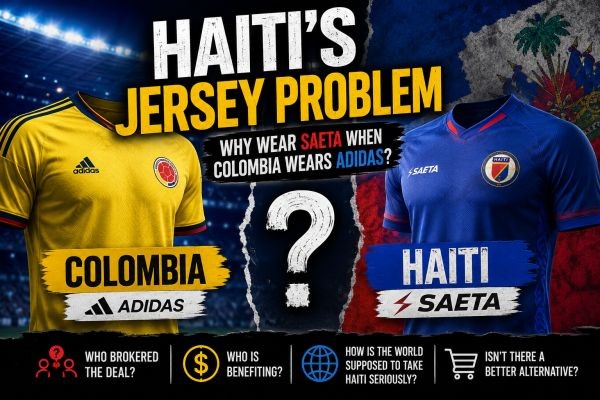
Why is Haiti wearing Saeta?
And perhaps more importantly:
Why is Colombia, one of South America's football powerhouses, wearing Adidas while Haiti is wearing a relatively unknown Colombian sportswear company that Colombia itself doesn't use?
These questions are not about disrespecting a brand. They are about understanding strategy, visibility, national image, and whether Haiti is maximizing its opportunities on the international stage.
The Global Football Jersey Arms Race
Modern football jerseys are no longer simply uniforms.
They are:
National symbols
Marketing vehicles
Revenue generators
International branding tools
Recruitment and sponsorship assets
The biggest football nations understand this.
Look at the world's leading kit manufacturers:
Adidas AG
Nike, Inc.
PUMA SE
New Balance Athletics, Inc.
Umbro
Kappa
These companies invest millions into:
Research and development
Performance fabrics
Global marketing
Retail distribution
International athlete sponsorships
When a national team signs with one of these brands, the partnership often extends beyond apparel.
It becomes part of the country's international image.
Colombia's Choice Says A Lot
The Colombian national team wears Adidas.
That fact alone should make people pause.
Saeta is a Colombian company.
Yet Colombia itself chose Adidas.
Why?
The answer is likely simple:
Because Adidas offers:
Global recognition
Worldwide retail distribution
Advanced technology
Greater sponsorship value
Larger marketing reach
If Colombia believed Saeta was the optimal global partner for its national team, wouldn't Colombia itself be wearing Saeta?
Instead, Colombia chose one of the world's most recognizable sports brands.
That raises an obvious question:
Why was a different standard considered acceptable for Haiti?
Who Is Saeta?
Saeta is a Colombian sportswear company that has supplied uniforms to numerous clubs and national teams throughout Latin America.
Its portfolio includes partnerships with:
National Teams
Haiti
Colombia Track & Field
Costa Rican institutions
Clubs
Once Caldas
Santa Fe
América de Cali
Cúcuta Deportivo
Millonarios
Real Cartagena
Deportivo Pasto
These are legitimate football organizations.
No one can claim Saeta is a fake company.
However, legitimacy and prestige are not necessarily the same thing.
A company can be real, established, and functional while still lacking the global influence of Adidas, Nike, Puma, or Umbro.
The Website Problem
In today's world, perception matters.
A lot.
When supporters, sponsors, journalists, and international fans visit a national team's kit supplier, what do they see?
Many observers note that Saeta's website appears similar to a standard Shopify implementation.
There is nothing inherently wrong with Shopify.
Thousands of successful companies use it.
However, for the official outfitter of a national football team, expectations are different.
Fans expect:
Strong storytelling
Rich brand history
Premium presentation
International ordering
Professional merchandising
Global visibility
When the supplier's online presence feels small, it can create the impression that the partnership itself is small.
Whether fair or unfair, perception becomes reality.
Haiti's Visibility Challenge
Haiti already faces an uphill battle in international football.
The country must compete against nations with:
Larger populations
Larger economies
Bigger football infrastructures
Larger sponsorship ecosystems
Because of these realities, every branding decision matters.
Every partnership matters.
Every opportunity to elevate Haiti's image matters.
A national jersey supplier should help:
Increase visibility.
Increase merchandise sales.
Increase international exposure.
Attract sponsors.
Build national pride.
The question becomes:
Has the Saeta partnership accomplished those goals?
That is a fair question for supporters to ask.
Who Brokered The Deal?
Perhaps the most interesting question is not why Haiti wears Saeta.
It is:
Who made the decision?
National kit agreements typically involve:
Football federation executives
Commercial partners
Licensing agreements
Sponsorship negotiations
Manufacturing contracts
Supporters deserve transparency.
Questions that deserve answers include:
How much revenue does Haiti receive?
Was there a competitive bidding process?
Were larger manufacturers approached?
What alternatives were considered?
What benefits does Haiti receive beyond uniforms?
What percentage of merchandise sales returns to Haitian football?
Transparency builds trust.
Silence creates speculation.
Who Is Pedro Aníbal Carrero López?
One name frequently associated with Saeta is Pedro Aníbal Carrero López.
He has been connected with the company through leadership and business operations.
However, public information does not indicate that he is Haitian.
He appears to be primarily connected to Colombian sports apparel and football business activities.
That raises another legitimate question:
What relationship led Saeta to become Haiti's long-term supplier beginning in 2013?
There may be a perfectly reasonable explanation.
Perhaps Saeta offered:
Better pricing
Better customization
Better revenue sharing
Greater flexibility
Faster production
Those are all plausible possibilities.
But supporters rarely receive detailed explanations.
As a result, speculation fills the void.
The Opportunity Cost
Every sponsorship decision carries opportunity costs.
Imagine if Haiti partnered with:
Adidas
Nike
Puma
Umbro
Macron
Joma
Hummel
The potential advantages could include:
Global Retail Presence
Haiti jerseys available worldwide.
Increased Merchandise Revenue
More sales means more money for football development.
Better Brand Exposure
Millions of consumers see the Haitian crest.
Recruitment Advantages
Players often appreciate elite equipment and support systems.
Sponsorship Synergy
Major brands can attract additional commercial partners.
A Better Alternative
Rather than merely criticizing the current arrangement, let's discuss solutions.
Option 1: Competitive Bidding
The Haitian Football Federation should publicly invite proposals from multiple manufacturers.
Transparency would increase confidence in the final decision.
Option 2: Tiered Partnership Model
Haiti could pursue a partnership with:
Adidas
Nike
Puma
Macron
Joma
Hummel
while retaining local manufacturing participation where possible.
Option 3: Haitian-Inspired Global Design
A major international supplier could create:
Haitian cultural collections
Limited-edition jerseys
Heritage editions
Diaspora-focused merchandise
This would celebrate Haiti while expanding global sales.
Option 4: Public Reporting
Release annual reports showing:
Sponsorship value
Merchandise sales
Revenue distribution
Grassroots football investments
Supporters deserve to know how commercial deals benefit Haitian football.
The Bigger Question
Ultimately, this debate is not really about Saeta.
It is about ambition.
It is about whether Haiti sees itself as a football nation worthy of the same global standards pursued by larger countries.
No one is suggesting that a logo alone wins matches.
Players win matches.
Coaches win matches.
Development systems win matches.
But branding matters.
Visibility matters.
Perception matters.
And when the Colombian national team chooses Adidas while Haiti wears a Colombian brand that Colombia itself does not use, supporters are naturally going to ask questions.
The real issue is not whether Saeta is good enough.
The real issue is whether Haiti is aiming high enough.
Until supporters receive clear answers about how the partnership was negotiated, what benefits it delivers, and how it advances Haitian football, those questions will continue to be asked.
And perhaps they should be.