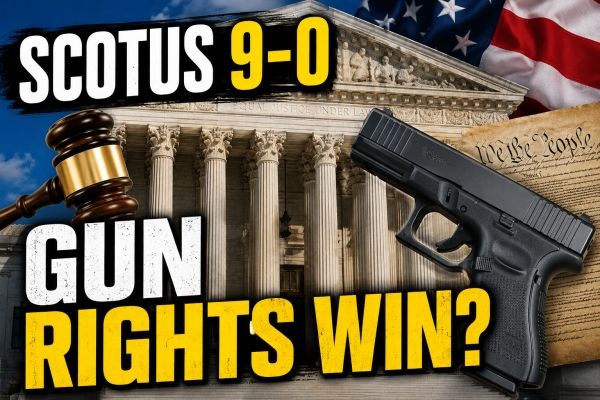
SCOTUS Unanimously Limits Federal Gun Ban Used Against Hunter Biden
In a unanimous 9-0 decision, the U.S. Supreme Court has significantly narrowed how the federal government can enforce a gun restriction that prohibits unlawful drug users from possessing firearms.
The ruling is drawing national attention not only because of its implications for gun rights and marijuana users, but also because the same federal statute was used in the high-profile prosecution of Hunter Biden in 2024.
While the Court did not strike down the law entirely, its decision could reshape how federal authorities apply firearm restrictions to millions of Americans.
The Case Before the Court
The case centered on Ali Hemani, a Texas man who challenged a federal law that bars unlawful drug users from possessing firearms.
Federal prosecutors argued that Hemani's marijuana use alone was enough to justify the firearm prohibition.
The Supreme Court disagreed.
Writing for the Court, Justice Neil Gorsuch concluded that the government failed to demonstrate that Hemani's marijuana use, by itself, was sufficient grounds to strip him of a constitutional right protected by the Second Amendment.
The justices emphasized that constitutional rights cannot be removed based on broad assumptions about entire groups of people without evidence that the restriction is justified.
What the Court Did—and Didn't—Do
The ruling was intentionally narrow.
The Supreme Court did not eliminate the federal statute that restricts firearm possession by unlawful drug users.
Instead, the Court held that the government cannot automatically assume that all marijuana users are dangerous and therefore prohibited from owning or possessing firearms.
The decision leaves open the possibility that Congress and regulators may still impose restrictions on:
- Individuals suffering from drug addiction
- People who are currently intoxicated
- Individuals proven to be dangerous
- Other firearm restrictions tied to drug use that can survive constitutional scrutiny
In other words, the law survives—but its application is now more limited.
Why Hunter Biden Is Part of the Conversation
The decision immediately sparked comparisons to Hunter Biden's federal firearm case.
In 2024, Hunter Biden was convicted under the same federal statute after prosecutors alleged that he possessed a firearm while unlawfully using controlled substances.
Legal observers note that the Supreme Court's decision does not automatically affect past convictions. However, the ruling could influence future legal challenges involving the same law and how courts evaluate restrictions on firearm ownership.
Supporters Call It a Major Second Amendment Victory
Gun rights advocates are celebrating the ruling as a significant win for constitutional freedoms.
- The Second Amendment protects fundamental rights.
- Millions of Americans legally use marijuana under state law.
- The government should prove dangerousness before removing constitutional protections.
- Broad firearm bans based solely on marijuana use may be unconstitutional.
Critics Raise Public Safety Concerns
Critics argue that guns and drug use can be a dangerous combination and that the ruling could make firearm regulations harder to enforce.
Others worry that future firearm safety measures may face additional constitutional challenges.
The Bottom Line
The Supreme Court did not strike down the federal gun law used against Hunter Biden.
What it did do was narrow the government's ability to apply that law to marijuana users solely because they use marijuana.
The ruling reinforces the principle that constitutional rights cannot be taken away without sufficient justification while leaving room for restrictions aimed at individuals who are intoxicated, addicted, or demonstrably dangerous.
As debates over gun rights, marijuana legalization, and constitutional protections continue, this decision is likely to have lasting legal and political consequences.
What Do You Think?
Is this a major victory for constitutional rights and the Second Amendment?
Or does the ruling create new risks by making firearm regulations harder to enforce?
Share your thoughts in the comments below.